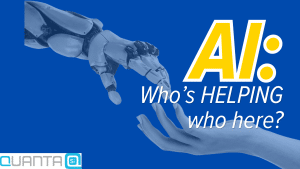
AI promises to make businesses more efficient.
And in many ways, it does.
Teams can draft emails faster, summarize meetings in seconds, generate reports with minimal effort, and quickly find information that once required hours of research. The productivity gains are real.
But there’s a growing challenge many organizations are beginning to experience: employees are spending more time managing AI than benefiting from it.
When Employees Become the Integration Layer
Imagine a typical workflow.
An employee exports information from one application, pastes it into an AI tool, reviews the output, makes corrections, and then manually moves the results into another system.
Repeat that process dozens of times a day, across multiple employees, and the efficiency gains start to shrink.
In many organizations, AI hasn’t eliminated manual work. It’s simply changed the type of work being performed.
Instead of handling repetitive tasks directly, employees become the bridge between disconnected technologies.
They’re moving data, validating results, providing additional context, and correcting outputs that are close but not quite ready for business use.
The Hidden Cost of “AI Productivity”
On the surface, things may appear more productive than ever.
Reports are completed faster. Communications are drafted more quickly. Information is easier to access.
Yet behind the scenes, many employees are spending significant time:
- Copying information between systems
- Re-entering the same data multiple times
- Refining prompts to get better results
- Verifying AI-generated content
- Correcting inaccuracies and formatting issues
- Managing workflows that don’t fully connect
The result is a new category of administrative overhead that many businesses didn’t anticipate.
Employees stay busy, but not always on work that directly creates value.
Why This Happens
The issue isn’t AI itself.
The challenge is often how AI gets introduced into the business.
Organizations frequently deploy AI tools one at a time. An AI assistant for email. An AI feature in the CRM. A separate AI platform for reporting. Another tool for document generation.
Individually, each solution may offer meaningful benefits.
Collectively, however, they can create fragmented workflows if data doesn’t move seamlessly between systems.
When technology ecosystems aren’t connected, people naturally step in to fill the gaps.
That’s when employees inadvertently become “human middleware”, serving as the connection point between applications that should be communicating automatically.
The Real Goal Isn’t More AI
Many businesses assume the next step is adding even more AI.
In reality, the bigger opportunity often lies elsewhere.
Before investing in additional tools, organizations should examine how information flows through the business.
Consider questions such as:
- Where is critical business data stored?
- How many times is that information manually touched?
- Are systems sharing information automatically?
- Which processes still rely on copy-and-paste workflows?
- How much employee time is spent validating data between applications?
The answers often reveal opportunities to simplify operations and reduce manual effort.
Integration Creates the Greatest Value
The most successful AI initiatives aren’t necessarily the ones using the most advanced technology.
They’re the ones where data, workflows, and business systems work together effectively.
When properly integrated, AI can:
- Automatically access relevant business information
- Update multiple systems without manual intervention
- Trigger workflows across departments
- Reduce duplicate data entry
- Deliver consistent, reliable outputs
At that point, employees can focus on the work that requires human expertise rather than facilitating communication between software platforms.
Focus on Outcomes, Not Tools
Too often, organizations measure success by the number of AI solutions they’ve deployed.
A better metric is whether employees are spending less time on administrative tasks and more time on customer service, decision-making, collaboration, and problem solving.
Technology should remove friction, not introduce new layers of complexity.
If your team is constantly switching between applications, manually transferring information, or spending excessive time correcting AI-generated outputs, the issue may not be the AI platform itself. It may be the overall workflow design surrounding it.
Final Thoughts
AI has enormous potential to improve productivity, but only when it’s implemented as part of a broader business process strategy.
The organizations seeing the greatest return from AI aren’t simply adding tools. They’re building connected environments where information flows naturally and automation supports the way people work.
Your employees shouldn’t spend their day helping software communicate with other software.
They should be focused on serving customers, solving business problems, driving growth, and making informed decisions.
At QuantaSi, we help organizations evaluate not only which AI tools to adopt, but how those technologies fit into the broader business ecosystem. The goal isn’t to add more technology. It’s to ensure technology reduces workload, improves efficiency, and creates measurable business value.