When people think about IT leadership, they often think about technology.
Infrastructure. Security. Applications. Projects.
But if you’ve spent any time leading an internal IT team, you know the job is just as much about people, priorities, and business decisions as it is about technology.
In many organizations, some of the most challenging parts of the role have nothing to do with servers, networks, or cybersecurity.
They’re about alignment.
Balancing Competing Priorities
Every department has a different view of what IT should deliver.
Operations wants reliability.
Sales wants speed.
Finance wants cost control.
Leadership wants innovation, security, and business continuity.
And they all want it now.
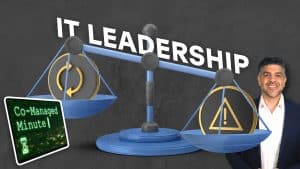
The challenge is that these priorities don’t always point in the same direction.
A security improvement may introduce additional steps for users.
A new process may improve governance while slowing down a workflow.
An aging platform may need to be replaced, but other business initiatives may take priority.
As an IT leader, you’re often the person responsible for navigating those competing interests and finding a path forward that supports the business as a whole.
Technology Decisions Are Business Decisions
One of the biggest shifts that occurs as IT leaders advance in their careers is realizing that technology decisions rarely exist in isolation.
Every significant IT decision affects people, budgets, productivity, risk, and business outcomes.
That’s why effective IT leadership isn’t just about knowing the right technical answer.
It’s about understanding:
- When to push for change
- When to build consensus
- When to accept incremental progress
- When to prioritize risk reduction
- When business realities require a different approach
Technical expertise remains important, but communication, influence, and business acumen become equally valuable.
The most successful IT leaders learn how to connect technology decisions to organizational goals rather than treating them as purely technical initiatives.
The Constant Pull Between Strategic and Operational Work
At the same time you’re helping guide business decisions, the day-to-day responsibilities of IT never stop.
Support tickets still need attention.
Projects still require oversight.
Security initiatives still need to move forward.
Vendors still need management.
Incidents still occur.
For many internal IT leaders, this creates a constant tension between strategic responsibilities and operational demands.
The organization expects you to think strategically, but operational issues can easily consume the time needed for planning, communication, and long-term decision making.
Without enough bandwidth, IT can become trapped in a cycle of reacting rather than leading.
Why Many Organizations Choose a Co-Managed IT Model
One of the biggest advantages of a co-managed IT partnership is the ability to create additional capacity for internal IT leadership.
By augmenting your team with experienced resources, routine operational tasks, monitoring activities, user support, and specialized expertise can be shared across a larger team.
That creates room for internal IT leaders to focus on the areas where they provide the greatest value:
- Strategic planning
- Security and risk management
- Technology roadmaps
- Executive communication
- Vendor relationships
- Business alignment
The goal isn’t to replace your internal team.
It’s to strengthen it.
A successful co-managed relationship allows your organization to retain ownership of strategy, priorities, and decision-making while gaining access to additional resources when needed.
Stronger IT Leadership Creates Better Business Outcomes
The organizations that get the most value from technology aren’t necessarily the ones with the largest IT departments.
They’re the ones where IT leaders have the time and support to operate strategically.
When leaders can focus more on planning and less on constant firefighting, communication improves, projects stay on track, risks are addressed sooner, and technology becomes more aligned with business goals.
That’s where co-managed IT can make a meaningful difference.
Not by taking control away from your team, but by giving your IT leaders the support they need to focus on what matters most: helping the business move forward with confidence.
If your internal IT team is spending more time reacting than planning, a co-managed IT approach could provide the additional capacity needed to strengthen both daily operations and long-term technology leadership.